Vibrant Veggies: Infusing Life into Your Projects with Graphic Clipart
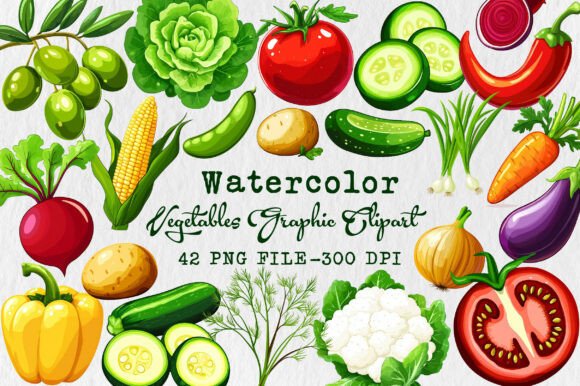
When you are tasked with creating materials for a farmers market, a meal prep blog, or a health-focused brand, the visual assets you choose define the audience's immediate reaction. Stock photography can often feel sterile or overly generic, failing to capture the warmth of a home kitchen or the freshness of a harvest. This is where high-quality Vegetables Graphic Clipart becomes an essential tool in your design arsenal. We aren't talking about low-resolution pixel art from the early 2000s; we are discussing a curated collection of 42 distinct designs rendered at 300 DPI. This level of detail ensures that whether you are printing a large-scale banner or shrinking an icon down for a mobile interface, the integrity of the image remains intact.
The aesthetic appeal of this particular set lies in its balance of realism and illustrative charm. It bridges the gap between a rigid vector style and the softness of watercolor, offering a versatile look that feels organic without being messy. Because the files are delivered as PNGs with transparent backgrounds, they act as digital stickers. You can layer them over textured paper, place them in the corner of a recipe card, or integrate them into a complex collage without worrying about unsightly white boxes or jagged edges. This versatility makes them a staple for anyone working in packaging design or editorial design, where blending assets seamlessly is paramount.
Strategic Applications: From Kitchen Tables to Digital Storefronts
Understanding the utility of these assets requires looking beyond simple decoration. For the small business owner or entrepreneur, this clipart package is a strategic branding tool. Consider the food and beverage industry: visual consistency builds trust. If you are launching a line of cold-pressed juices, using these specific vegetable illustrations across your social media graphics, your shipping labels, and your website header creates a cohesive brand identity. It signals to your customer that you care about the details. The "personality" of the clipart—colorful, fresh, and detailed—communicates health, vitality, and transparency.
For educators and content creators, the applications are equally robust. Classroom materials often suffer from a lack of engagement due to boring visuals. High-quality design assets like these can transform a standard worksheet into an interactive experience. The visual hierarchy is crucial here; using a bright, high-resolution carrot or broccoli stalk as a bullet point or a section divider draws the eye exactly where you want it. It breaks up dense text, making information easier to digest—a vital principle in web design and instructional layouts.
Furthermore, the rise of the "creator economy" has seen a massive spike in the demand for printable products. Planners, journals, and sticker sheets are high-margin digital goods. With 42 designs included, you have enough variety to create a comprehensive themed collection. You can design a "Weekly Meal Planner" sticker set that offers different vegetables for different days, or create custom sublimation prints for tote bags and aprons. The 12x12 inch file size is specifically optimized for scrapbooking and sublimation workflows, ensuring you don't have to waste time resizing or worrying about resolution loss.
Technical Excellence: Resolution, Color, and File Integrity
In the professional realm, technical specifications often dictate the viability of an asset. A common frustration with lower-tier clipart is color space incompatibility or poor resolution. This package addresses those pain points head-on. At 300 DPI, these files are print-ready. This is the industry standard for high-fidelity printing, meaning you can send these directly to a print-on-demand service for mugs, t-shirts, or business cards without fear of pixelation.
The transparent background is perhaps the most critical feature for digital manipulation. In software like Canva, Photoshop, or Cricut Design Space, time is money. A transparent PNG allows for "drag-and-drop" efficiency. You do not need to spend valuable minutes using the magic wand tool to remove backgrounds, which often results in halos or rough edges. This clean cutout ensures that the clipart sits naturally on top of any color palette or pattern, maintaining the professional polish required for packaging design and logo design elements.
Color fidelity is another standout characteristic. The "Colorful" descriptor isn't just marketing speak; the illustrations capture the subtle gradients found in nature—the deep greens of kale fading into lighter stems, the rich orange of a bell pepper. This richness helps in creating visual hierarchy. By using these vibrant assets, you can create focal points that anchor your layout. For example, in a busy newsletter layout, a high-quality vegetable illustration can serve as a resting point for the eye, guiding the reader through your content flow naturally.
Maximizing Impact: Design Pairings and Practical Tips
To get the most out of your Vegetables Graphic Clipart, consider how they interact with your typography. This is where the concept of font pairing becomes relevant. Because the clipart is detailed and organic, it pairs exceptionally well with clean, modern typography. A bold sans serif font for headlines provides a strong, contemporary contrast to the natural curves of the vegetables, ensuring readability. Alternatively, if you are aiming for a more artisanal, "farm-to-table" vibe, pairing the clipart with a handwritten font or a script font can enhance that personal touch, provided the script remains legible at smaller sizes.
When evaluating the fit for your project, consider the "visual weight" of the designs. A detailed broccoli floret has a heavier visual weight than a simple green bean. Use the heavier images for hero sections or focal points, and the lighter, simpler shapes for background textures or accent icons. This balance prevents your design from feeling cluttered. For brand identity work, consistency is key. Stick to a specific color palette derived from the clipart to unify your marketing materials. If your primary brand color is green, use the spinach or lettuce graphics to reinforce that association.
Finally, regarding licensing and usage: the inclusion of commercial use rights is a significant value proposition. It removes the legal ambiguity that often plagues digital creators. You can confidently sell the end products you create—be it a printed t-shirt, a digital planner, or a set of recipe cards—knowing you have the rights to do so. This freedom allows you to experiment with different markets. You might start by designing a blog header and realize you can monetize those same assets by selling a "Kitchen Branding Kit" to other small business owners.
Final Thoughts on Creative Utility
The true power of this Vegetables Graphic Clipart package lies in its adaptability. It is not just a collection of images; it is a toolkit for storytelling. Whether you are a blogger trying to make a recipe jump off the page, a marketer designing a campaign for a health food startup, or a crafter looking for the perfect element for a handmade card, these assets provide the quality and flexibility required to execute your vision professionally. By leveraging the high resolution, transparent backgrounds, and commercial rights, you position yourself to produce work that is not only visually appealing but also commercially viable.